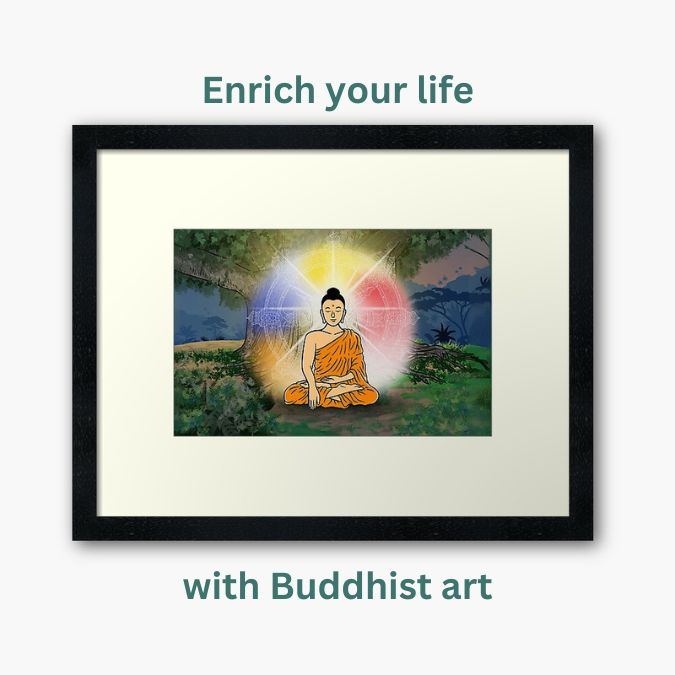
Sutra of the Eight Realisations of Great Beings
For all disciples of the Buddha,
Each morning and night,
Recite with a sincere mind,
These eight realisations of a bodhisattva.
First:
Realise that this world is impermanent
and that nations are dangerous and fragile.
The four great elements lead to suffering and are empty
and the five aggregates are without a self.
All things arise, cease, change, and become different;
They are illusory, not real, and cannot be controlled.
The mind is the source of unwholesomeness
and the body is a gathering of wrongdoings.
Contemplate this and you will gradually turn away from the cycle of birth and death.
Second:
Realise that more desire causes suffering.
The weariness of the cycle of birth and death
arises from greed and desire.
Lessen desire and be without any wishes and
the body and mind will be at ease.
Third:
Realise that the mind cannot be satisfied
but only seeks more,
increasing its wrongdoing and unwholesomeness.
Bodhisattvas are not like this;
they are always satisfied with what they have,
is peaceful in poverty, and upholds the Way.
Wisdom is their only concern.
Fourth:
Realise that laziness leads to downfall.
Be diligent
and break through the evil of the affliction.
Defeat the four kinds of Mara
and escape the prison of the five aggregates and three realms.
Fifth:
Realise that ignorance gives rise to the cycle of birth and death.
Bodhisattvas are always mindful,
study widely, listen more,
increase their wisdom,
and become more eloquent
in order to teach all beings
great joy.
Sixth:
Realise that those who are poor and suffering have more resentment,
and that this leads them to create unwholesome conditions.
Bodhisattvas practise giving
and have equal concern for friend and foe.
They do not recollect past unwholesome deeds committed against them,
nor do they hate unwholesome people.
Seventh:
Realise that wrongdoing comes from the five desires.
Even though you are an ordinary person,
do not be stained by worldly pleasures.
Always be mindful of the triple robe,
the bowl, and dharma instruments,
and be willing to leave home,
uphold the Way purely,
practise the holy life well,
and have compassion for all beings.
Eighth:
Realise that the cycle of birth and death is a raging fire
and that suffering is boundless.
Initiate the Mahāyana mind
to universally help all beings
and vow to shoulder
the boundless suffering of sentient beings
so that all sentient beings
may reach great joy.
These eight realisations are the realisations of all Buddhas and bodhisattvas.
Diligently practise the Way
and compassionately cultivate wisdom.
Take the Great Dharma Vessel
and reach the shore of nirvāṇa,
then return again to the cycle of birth and death
to liberate sentient beings.
Use these eight realisations
to teach all beings
and allow sentient beings
to awaken to the suffering of the cycle of birth and death,
turn away from the five desires,
and cultivate the mind on the noble path.
If disciples of the Buddha
recite these eight realisations
in every thought,
they can eliminate boundless wrongdoings,
progress towards bodhi,
and quickly attain right enlightenment,
forever cut off birth and death
and always be happy.
佛說八大人覺經
後漢安息國沙門安世高譯
為佛弟子,常於晝夜,至心誦念,八大人覺︰
第一︰覺悟世間無常,國土危脆;四大苦空,五陰無我;生滅變異,虛偽無主;心是惡源,形為罪藪;如是觀察,漸離生死。
第二︰覺知多欲為苦。生死疲勞,從貪欲起;少欲無為,身心自在。
第三︰覺知心無厭足,惟得多求,增長罪惡;菩薩不爾,常念知足,安貧守道,惟慧是業。
第四︰覺知懈怠墮落,常行精進,破煩惱惡,摧伏四魔,出陰界獄。
第五︰覺悟愚痴生死。菩薩常念,廣學多聞,增長智慧,成就辯才,教化一切,悉以大樂。
第六︰覺知貧苦多怨,橫結惡緣,菩薩布施,等念怨親,不念舊惡,不憎惡人。
第七︰覺悟五欲過患。雖為俗人,不染世樂;常念三衣,瓦鉢法器;志願出家,守道清白。梵行高遠,慈悲一切。
第八︰覺知生死熾燃,苦惱無量;發大乘心,普濟一切。願代眾生,受無量苦;令諸眾生,畢竟大樂。
如此八事,乃是諸佛菩薩大人之所覺悟。精進行道,慈悲修慧,乘法身船,至涅槃岸;復還生死,度脫眾生。以前八事,開導一切,令諸眾生,覺生死苦,捨離五欲,修心聖道。
若佛弟子,誦此八事,於念念中,滅無量罪;進趣菩提,速登正覺;永斷生死,常住快樂。
About Venerable Juewei, Director Nan Tien Institute Humanistic Buddhism Centre
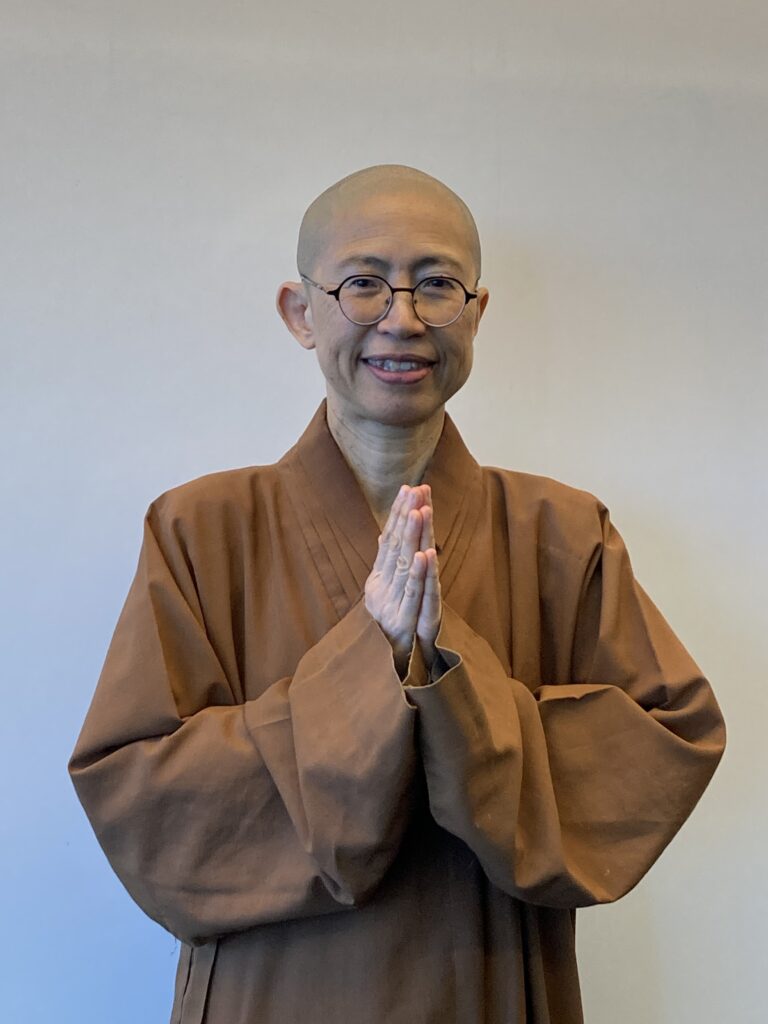
Venerable Dr Juewei is the Director of Nan Tien Institute’s Humanistic Buddhism Centre and Head of Program for the Institute’s Applied Buddhist Studies and Humanistic Buddhism programs. Venerable Dr Juewei holds a Ph.D. in Religious Studies, a Master of Arts in Buddhist Studies, a Master of Business Administration, and a Master of Science in Computer Science and Engineering.
Venerable Juewei’s recent publications include ‘A Reflection on the Humanism in The Platform Sūtra of the Sixth Patriarch’ in Studies on Humanistic Buddhism, vol. 5, and ‘Flows of Innovation in Fo Guang Shan Oceania: transregional dynamics behind the Buddha’s Birthday Festival’ in Journal of Global Buddhism, vol. 23, no. 2. She is co-editor, with Professor Suzanne Franzway and Professor Stephen Hill, of Cultivating compassion: going beyond crises (Peter Lang, 2023). She is also on the editorial board of the Studies on Humanistic Buddhism journal.
Juewei’s research interests include Humanistic Buddhism, Buddhist acculturation, and Buddhist issues in modern society, including Buddhist Economics, Buddhist Ethics, Buddhism and Artificial Intelligence, and Buddhist responses to contemporary crises and social challenges. Besides research, Venerable Dr Juewei also teaches subjects such as Buddhism and Modern Society, Buddhist Ethics and subjects related to Chinese Buddhism.
Through the Humanistic Buddhism Centre, Venerable Dr Juewei leads a number of research projects, including the grant funded Buddhism in Australia project, the Buddhism in the Sea of Islands project, and the Humanistic Buddhism Special Interest Group. She also leads a number of engagement projects, including Communities of Practice (Sunday Check-in Sessions), and, since 2017, the collection and publication of real-life humanistic applications of Buddhist teachings in the Turning Points series.
In addition, Venerable Dr Juewei is an active member of the Fo Guang Shan Buddhist order. She has held many international positions within the order’s University Consortium and Temples, including University of the West and Hsi Lai Temple in California, USA, and Australia’s Nan Tien Temple.
Bio source: https://www.nantien.edu.au/about-us/faculty-and-staff/venerable-dr-juewei/