The Heart of Wisdom Sutra (Prajñāpāramitāhṛdaya)
At that time, the Blessed One was absorbed in the concentration of the countless aspects of phenomena called Profound Illumination.
At that time also Superior Avalokiteshvara, the bodhisattva, the great being, was looking perfectly at the practice of the profound perfection of wisdom, perfectly looking at the emptiness of inherent existence of the five aggregates also.
Then, through the power of Buddha, Venerable Shariputra said to Superior Avalokiteshvara, the bodhisattva, the great being, “How should a child of the lineage train who wishes to engage in the practice of the profound perfection of wisdom?”
Thus he spoke, and Superior Avalokiteshvara, the bodhisattva, the great being, replied to Venerable Shariputra as follows:
“Shariputra, whatever son or daughter of the lineage wishes to engage in the practice of the profound perfection of wisdom should look perfectly like this: subsequently looking perfectly and correctly at the emptiness of inherent existence of the five aggregates also.
“Form is empty; emptiness is form. Emptiness is not other than form; form also is not other than emptiness. Likewise, feeling, discrimination, compositional factors and consciousness are empty.
“Shariputra, like this all phenomena are merely empty, having no characteristics. They are not produced and do not cease. They have no defilement and no separation from defilement. They have no decrease and no increase.
“Therefore, Shariputra, in emptiness there is no form, no feeling, no discrimination, no compositional factors, no consciousness. There is no eye, no ear, no nose, no tongue, no body, no mind; no form, no sound, no smell, no taste, no tactile object, no phenomenon. There is no eye element and so forth up to no mind element and also up to no element of mental consciousness. There is no ignorance and no exhaustion of ignorance, and so forth up to no ageing and death and no exhaustion of ageing and death. Likewise, there is no suffering, origin, cessation or path; no exalted wisdom, no attainment and also no non-attainment.
“Therefore Shariputra, because there is no attainment, bodhisattvas rely on and abide in the perfection of wisdom; their minds have no obstructions and no fear. Passing utterly beyond perversity, they attain the final state beyond sorrow. Also, all the Buddhas who perfectly reside in the three times, relying upon the perfection of wisdom, become manifest and complete Buddhas in the state of unsurpassed, perfect and complete awakening.
“Therefore, the mantra of the perfection of wisdom, the mantra of great knowledge, the unsurpassed mantra, the equal-to-the- unequalled mantra, the mantra that thoroughly pacifies all suffering, since it is not false, should be known as the truth. The mantra of the perfection of wisdom is proclaimed:
_Tadyathā Gate Gate Pāragate Pārasaṃgate Bodhi Svāhā_
(Gone, gone, gone beyond, gone completely beyond, awakened, so be it!)
“Shariputra, a bodhisattva, a great being, should train in the profound perfection of wisdom like this.”
Then the Blessed One arose from that concentration and said to Superior Avalokiteshvara, the bodhisattva, the great being, that he had spoken well. “Good, good, O child of the lineage. It is like that. Since it is like that, just as you have revealed, the profound perfection of wisdom should be practiced in that way, and the tathagatas will also rejoice.”
About Venerable Gyatso
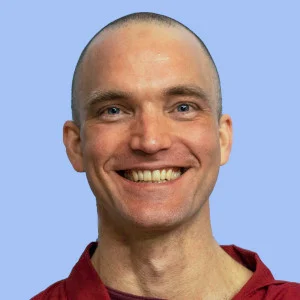
Ven. Thubten Gyatso grew up near the beautiful white-sand beaches of northwest Florida and spent his childhood lying in the sun and playing soccer. At the University of Florida he graduated with a BA in History and a minor in Business Administration, and then earned his MA in History. Determined to get out of the libraries, he spent the next 22 years wandering six continents as a ski instructor, waiter, and English teacher.
He first encountered Buddhism in 2005 with The Art of Happiness by His Holiness the Dalai Lama and was eager to learn more. Ven. Gyatso deepened his practice by volunteering at Dharma College in Berkeley as the registrar for eight months. He continued with the same Nyingma Mandala organization by taking a volunteer position as an English teacher in Sarnath, India with the Sarnath International Nyingma Institute for three years.
While living, eating, and practicing together with monks, he was able to deepen his commitment to the Dharma and train his mind to benefit all beings. A Goenka Vipassana retreat in Lumbini, Nepal had a profound impact by showing the calm, joy, and clarity of a focused mind. Shortly after, he decided that the monastic life was the most conducive to benefiting others, and started looking for a monastery to ordain.
He arrived at the Abbey in September 2021 after the Exploring Monastic Life course online, and recognized that Sravasti Abbey had all the conditions necessary for spiritual growth. His request for ordination was approved, and on May 20th, 2023, he ordained and became Ven. Thubten Gyatso.
Some of his opportunities for service at the Abbey include administration, infrastructure, and Dharma dissemination with the prison outreach team. He’s looking forward to one day joining the bhikshu sangha and attending the very first bhikshu posadha at Sravasti Abbey.